
Environment & Energy
POWERING THE BOOM, PART II: A POLICY ROADMAP FOR MANAGING TENNESSEE’S DATA CENTER GROWTH (2026)
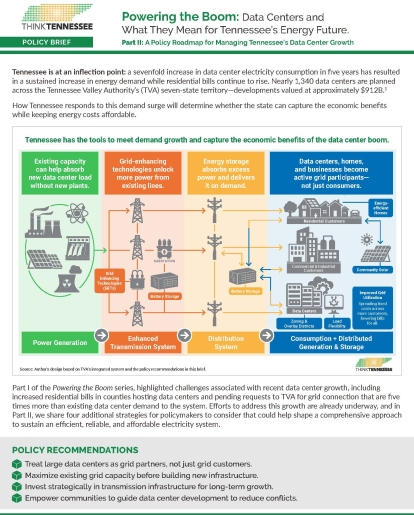
Tennessee is at an inflection point: nearly 1,340 data centers are planned across the Tennessee Valley Authority’s (TVA) seven-state territory, representing roughly $912 billion in development. That growth follows a sevenfold increase in data center electricity consumption over five years, a surge that Part I of the series found has led to increased residential electric bills in counties that host data centers.
Efforts to address this growth are already underway, and in Part II of the series, our policy brief examines how other states and regions are working through similar pressures and lays out four strategies policymakers could consider as they decide how to manage this growth without shifting costs onto households.
Click Image to View Full Report
POWERING THE BOOM, PART I: DATA CENTERS AND WHAT THEY MEAN FOR TENNESSEE’S ENERGY FUTURE (2026)
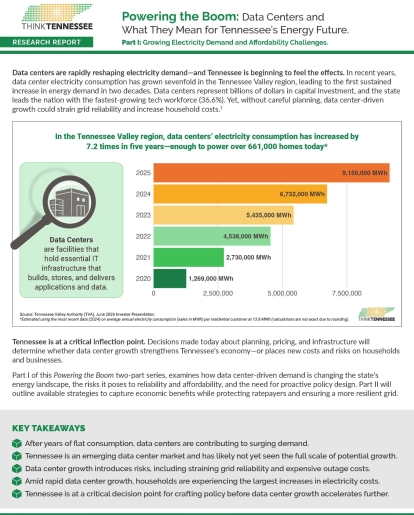
After more than a decade of flat or declining electricity consumption, Tennessee is experiencing its first sustained surge in energy demand, driven in part by a rapid influx of data centers. Data center electricity consumption in the Tennessee Valley region grew sevenfold between 2020 and 2025, reaching 8.3 million MWh – enough to power more than 661,000 homes.
Our research report examines how data center growth is transforming Tennessee’s energy landscape, from electricity demand to affordability challenges.
This report is the first installment in a two-part series. Part II will outline policy strategies available to Tennessee to capture the economic benefits of data center growth while protecting ratepayers and ensuring a more resilient grid.
Click Image to View Full Report
POWERING UP: TENNESSEANS COULD BENEFIT FROM ENERGY THAT IS MORE AFFORDABLE, RELIABLE, AND CLEAN (2025)
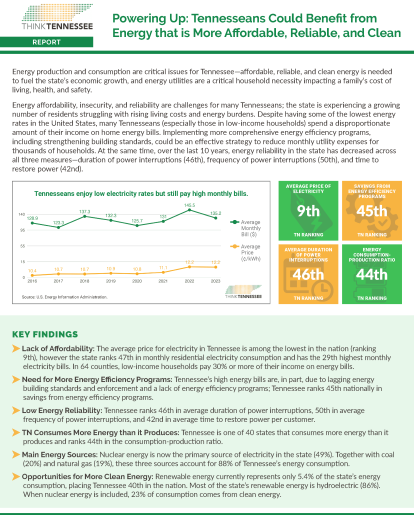
While Tennessee continues to be a leader in nuclear energy generation and its residents enjoy some of the lowest electricity rates in the nation, many households (particularly those with lower incomes) face disproportionate energy burdens due to high consumption and outdated building standards.
Our new report analyzes Tennessee’s energy industry across multiple dimensions, including consumption, production, and cost, providing comparisons by sector, geography, and over time. By prioritizing the implementation of robust energy efficiency programs, updating building codes, modernizing the state’s transmission grid, and investing in renewable energy sources, Tennessee can create cleaner, more reliable, and more affordable energy for residents.
Read the full report by clicking the image to the right. We recommend viewing the PDF in Adobe Reader for best readability of the interactive footnotes.
Click Image to View Full Report
STATE OF OUR STATE: ENVIRONMENT AND ENERGY (2018)
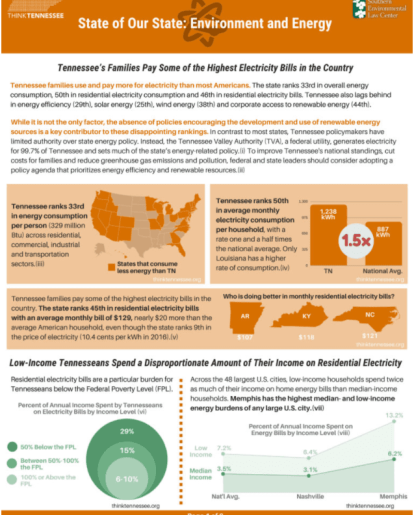
Tennesseans consume and pay more for electricity than most Americans. And the state lags others in production of and access to renewable energy.
Developed in partnership with the Southern Environmental Law Center, our policy brief addresses Tennessee’s performance in energy efficiency. The brief highlights policies adopted by other states that have been successful in increasing energy efficiency and reducing consumers’ energy costs by facilitating access to renewable energy sources.
Click Image to View Full Report